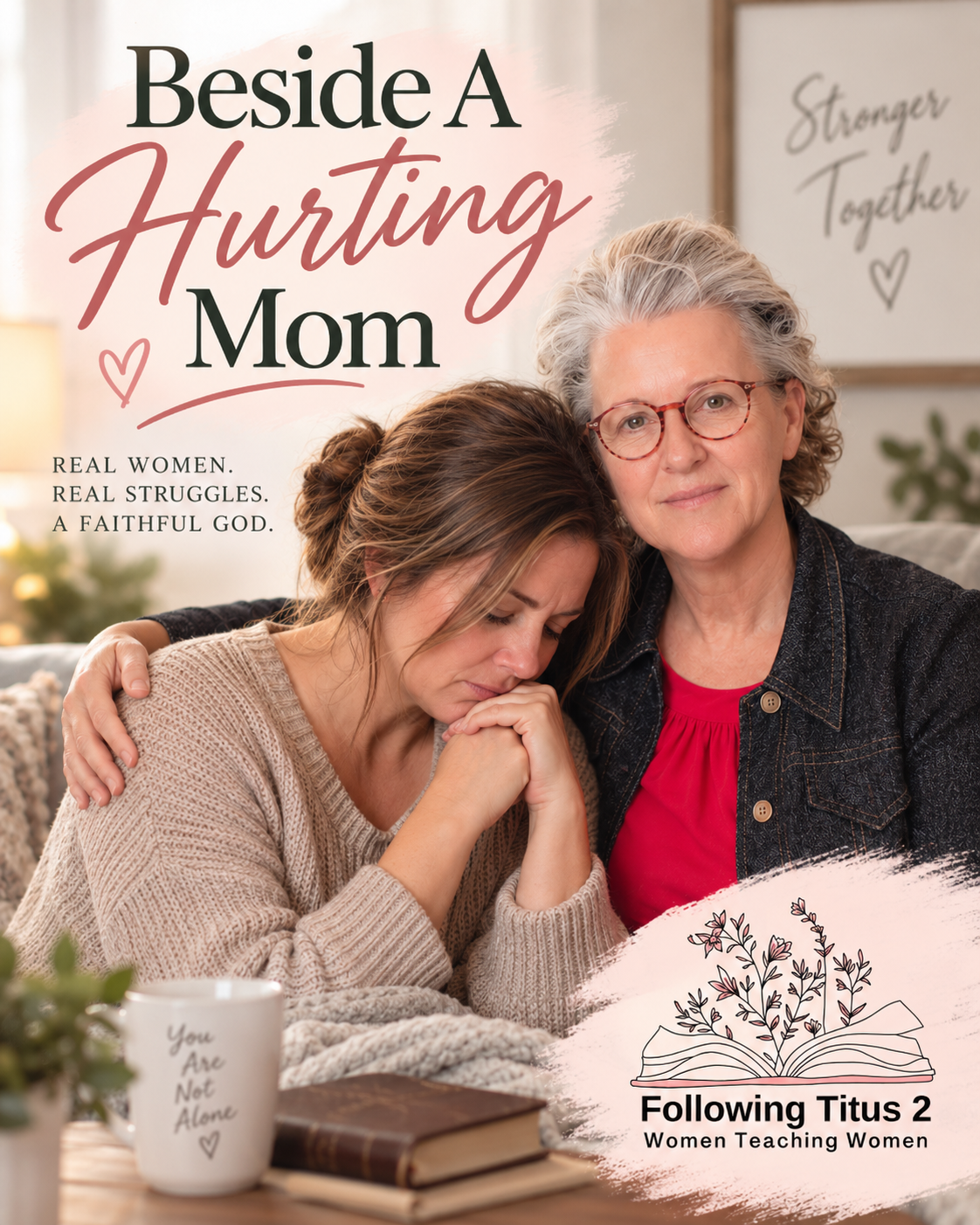
Beside a Hurting Mom
“Two are better than one, because they have a good return for their labor:
If either of them falls down, one can help the other up.”
Ecclesiastes 4:9–10
Were you drawn in this week, like I was?
Like so many others, I found myself watching pieces of the Lindsay Clancy trial over the past few weeks. During this process, I kept trying to understand: How could a mother kill… strangle her three little children?
As a leader, I’m careful when voicing my thoughts about something so painful and controversial. I want to be respectful, biblically grounded, and careful about where my own judgment belongs.
I usually have an opinion about most everything—until this.
This left me with far more questions than answers.
One moment I found myself standing on the sidelines with the prosecution, almost shouting questions at the screen.
Ask this. What about that? How could this have happened?
I listened to doctors and experts explain diagnoses, treatment decisions, medications and the care Lindsay received in the months leading up to that terrible day. I found myself frustrated by things I couldn’t understand and wondering whether someone, somewhere, had missed a desperate cry for help.
Then, almost without realizing it, I had crossed the courtroom.
Suddenly I was standing beside defense attorney Kevin Reddington asking an entirely different set of questions.
How did a mother struggling so desperately end up on so many psychiatric medications in such a short period of time? What was happening inside her mind? Who knew? Who didn’t know? What could anyone have done differently?
And then I would turn the trial off. Enough. It was simply too much.
Too much pain.
Too much suffering.
Too many questions.
So much wrong.
Three precious little children are gone.
A father has lost his children.
Grandparents have lost their grandchildren, while still loving a daughter who is at the center of an unimaginable tragedy.
No—it feels inadequate even to call it a tragedy, when in reality, it was criminal.
Three children are dead. A family has been shattered. And the legal questions remain unresolved.
Families have been torn apart.
Lives will never be the same.
Oh, my heart.
All week we have waited with bated breath and what do we get?
A MISTRIAL.
But somehow that word also describes the way I have felt all week: Unsettled.
I’ve come to realize there is no neat answer.
No explanation that makes the unbearable suddenly bearable.
And somewhere in all of those questions, I finally realized something.
I was trying to take a front row seat in a courtroom where perhaps I don’t belong.
I’m not the judge.
I’m not a juror.
I’m not a psychiatrist.
I’m not one of the doctors who treated her.
And I’m certainly not a member of that grieving family.
I don’t have the answers.
Truthfully, I don’t have a thimbleful.
But there is somewhere I can take a seat.
A place where you and I each belong.
Beside a hurting mom. And that’s where my heart keeps landing.
Because while none of us can go backward and change one moment of this terrible story, perhaps we can reach one mother who is walking through a difficult season right now.
One mom who feels overwhelmed.
One mom who thinks everyone else is handling motherhood better than she is.
One mom who has become very good at answering, “I’m fine.”
One mom who desperately needs someone to notice that she isn’t.
And if these little fingers tapping away on my keyboard can somehow connect that woman to encouragement, friendship, spiritual strength—or professional help when she needs it—then perhaps it is time for these little fingers to become warriors of hope.
“Bear ye one another’s burdens, and so fulfil the law of Christ.” Galatians 6:2

Motherhood was never intended to be lived entirely alone.
In Titus 2, older women are instructed to teach the younger women. But I believe there is something beautifully relational in that calling. This isn’t simply instruction shouted from a distance. It is women investing in women—teaching, encouraging, helping and walking alongside one another as we learn to live faithfully before God.
That is one reason I want to introduce you to my friend Cheryl Thornhill and The Kindred Motherhood.
Cheryl has a beautiful heart for moms and for creating a space where women can lay down the pressure to pretend they have everything together and discover that other mothers are walking through many of the same struggles.
Every Monday on YouTube, Cheryl opens the virtual door to Mama Monday—an at-home moms’ group offering connection, hope, biblical encouragement and strength for the everyday realities of motherhood.

And I love that. Because sometimes a lifeline doesn’t look dramatic.
Sometimes it looks like another mom saying, “Me too.”
Sometimes it’s somebody remembering your name isn’t just “mama.”
Sometimes it’s finding a place where you can show up tired, overwhelmed and carrying more than anyone realizes.
Sometimes it’s someone stopping long enough to pray with you.
Sometimes it’s a friend who notices that this week you just aren’t quite yourself.
And sometimes true friendship means loving someone enough to say, “I think we need to get you some more help.”
Maybe you live far from a church or community where you can easily join a moms’ group.
Maybe your season of life makes getting out of the house difficult.
Maybe you simply feel alone.
Technology cannot replace the people God places physically around us, but it can help build a bridge.
Through The Kindred Motherhood, you can link arms with Cheryl and other moms
who are also walking this road of motherhood.
Please hear my heart.
I would never suggest that a moms’ group, a friendship or one conversation could explain—or prevent—a tragedy as medically, emotionally and spiritually complex as the Clancy case.
But I will say this: We need one another.
We need churches where struggling people don’t feel that they have to hide.
We need women who will listen before they judge.
We need qualified doctors and therapists.
We need loving and understanding pastors—and pastors’ wives.
We need friends and families who pay attention.
We need communities where asking for help is not considered weakness.
And we need mothers to understand that there is absolutely no prize for carrying everything alone.
Let’s become warriors of hope.
I can notice.
I can listen.
I can reach out.
I can make the phone call, pull up another chair, point someone toward hope.
I can pray.
I can refuse to let a struggling woman quietly disappear into isolation.
And perhaps you can too.
So maybe that is what I take away from a week of following a trial I could never fully understand.
I don’t have to determine who is right from my place on the sidelines.
But I can do something much closer to home.
Because somewhere today there may be a mom who doesn’t need our opinion about a courtroom hundreds of miles away.
She needs to know that somebody sees her. Somebody cares. And she does not have to walk this road alone.
Friend, if motherhood feels lonely right now—or if you simply need some other moms to walk beside you—I encourage you to link arms with my friend Cheryl Thornhill through The Kindred Motherhood and Mama Monday.
There is strength in connection. There is hope in being seen. And sometimes one of the greatest gifts we can give another woman is simply to remind her:
You don’t have to carry this alone. I’m encouraging you to reach out today.
Because you are loved dearly,
Gena